|
MARKETING LIBRARY SERVICES
Creating a Statewide Campaign to Save IMLS
by Deb Marett
| The message we put out was simple: “Everyone loves libraries. Everyone needs libraries. This has nothing to do with politics. Speak up for your library.” |
On March 14, 2025, the president signed an executive order to eliminate seven federal agencies “to the maximum extent consistent with applicable law.” The list included IMLS, which is the only federal agency that provides grants and funding for libraries. A new acting director was installed; by April 1, all funding had been halted, and the staff was put on administrative leave. Historically, the total yearly budget for IMLS has been about $230 million, which is 0.004% of the entire federal budget.
Here in Wisconsin, our state interlibrary loan (ILL) system uses funds from IMLS. The Library Services and Technology Act (LSTA) Grants to States program makes it possible for libraries to keep up with technology needs, purchase other equipment, or pay for special programming. Some smaller rural and tribal libraries rely on IMLS funding to support staffing and would close without it. They also depend heavily on federal funding to provide broadband internet access in communities with limited online access. Wisconsin’s Department of Public Instruction uses IMLS funding for about half of its library staff salaries. All told, Wisconsin was scheduled to receive approximately $3.2 million from IMLS in 2025.
Even with all of these impacts, Wisconsin actually depends on IMLS much less than many other states. California and Texas lead the way with $15.7 million and $12.7 million in funding, respectively. They are followed by New York, Florida, and Pennsylvania. The funding allocation uses a population-based formula.
Nevertheless, these funds are vital for Wisconsin libraries. During the week of March 17, 2025, in response to news of the executive order eliminating IMLS, the Wisconsin library system directors group asked the state marketing cohort to design a postcard to distribute to every public library in the state. The postcard would give library patrons the opportunity to write to their federal elected officials, asking them to support and fund the agency. I’m one of the members of this state marketing cohort, which consists of system staffers who serve in marketing and communications roles for each of Wisconsin’s 15 library systems. Our group meets a few times a year to discuss ongoing projects, to share ideas and concerns, and to collaborate on statewide initiatives. Past projects have included educational webinars about marketing for library staffers and creating promotional stickers for Library Card Sign-Up Month.
Our first meeting about the IMLS cuts started with an overview of the situation, and we talked about the repercussions of the executive order. The request from the system directors was to design a postcard. But as we started going over what seemed to be a simple plan, questions started coming up—a lot of questions.
IMLS is a low-profile agency that almost no one outside of the library (or museum) world has even heard of. Most of the funding goes toward things that fly under the radar, that are logistically important but not necessarily visible to someone simply visiting their library. Why would patrons care about IMLS? How could we quickly explain to the general public what it is and why it’s important? What form would that communication take? What platform(s) should be used? And aside from the public, how many library staff members even know about this issue? How could we inform them and prepare them to answer questions from patrons? We realized that we needed to develop a much larger plan to create awareness about how this agency impacts Wisconsin’s libraries and why it would matter if it were eliminated.
Those questions led to bigger questions. As a publicly funded entity, what type of advocacy is a library allowed to engage in? And how could we run a campaign like this without making it political, which would alienate many patrons and staff members?
Educate vs. Advocate
We reached out to a few people with experience in nonprofit advocacy to find out more about which processes are appropriate for a library to participate in. What we learned, basically, is that the key word is education. We couldn’t tell people what to say to their elected officials or ask them to vote a certain way. What we could do is provide information showing why that federal agency makes a difference at the local level and how it could impact communities if it were gone. The plan became telling the story of IMLS—what it does and how it impacts Wisconsin libraries.
We focused on specific examples showing real-life scenarios, such as the fact that the ILL system in Wisconsin is used more than in any other state, and it might completely shut down without this dedicated funding. Our rural libraries can get books from all over the state and, in some cases, the country. This makes a huge difference for patrons living in small communities, whose libraries’ collections are limited. We also showcased how IMLS funding helps money stretch further and reduces redundancies by placing certain resources at the state level, rather than each library or system having to purchase items or services locally. We showed that, if IMLS were shuttered, every Wisconsin library would be impacted, and patrons would notice the changes.
Leaving Politics Out of It
When it came to politics, rather than shrink from it, we decided to call out the truth: This was not a political issue. IMLS has historically been a thoroughly nonpartisan agency and has had strong, almost unanimous support from both sides of the aisle. While it was a Republican-led administration that tried to close it down, both Republicans and Democrats in Congress had always been highly supportive. We also had the numbers to show that closing IMLS wasn’t a cost-saving move. Our aim was to remind people that funding libraries had never been—and should never be—tied to politics.
The message we put out was simple: “Everyone loves libraries. Everyone needs libraries. This has nothing to do with politics. Speak up for your library.”
All campaign messaging was kept positive and focused on the resources and impact of libraries in their communities. Every time we did a call for action, the message was, “Tell your elected officials what the library means to you” or “Tell your representatives in Congress why libraries matter to you.” In this way, we were not telling them what to say or what to ask for. We were educating people and asking them to tell their representatives in Washington what they thought about their libraries.
The Plan
In the end, we came away with an outline for two full-blown educational/awareness campaigns—one for the general public and one for library staff. Even before that work could begin, the first thing was to create an easily identified logo and name for the campaign. The final vote went to “Speak Up for Libraries.” We had a plan and divvied up the work—and we were ready to dive in.
The order had been signed on Friday, March 14, 2025. Our initial discussions were complete and our plans were made by the end of the day on Wednesday, March 19.
The Public Campaign for Patrons and the Press
We had a variety of resources created and sent out to each library system in the state to be shared with patrons to educate people about what IMLS is, what it does, and why it is important. All of the resources used the same branding and messaging, so all communication across the state would have the same look. Some of them were created in Canva so a library could add its own logo. Here’s what we made:
- Campaign name (Speak Up for Libraries) and logo
- A public-facing website (mywisconsinlibrary.org) that explains the situation and why it matters to local libraries. It includes links to news articles and other resources with more information. During the campaign, the site was updated weekly or any time new information came up.
- Social media posts with images and text that linked to the website
- Press releases
- Informational posters and fliers
- A QR code that took people to the website
- Bookmarks with the QR code that we put into patrons’ books at checkout
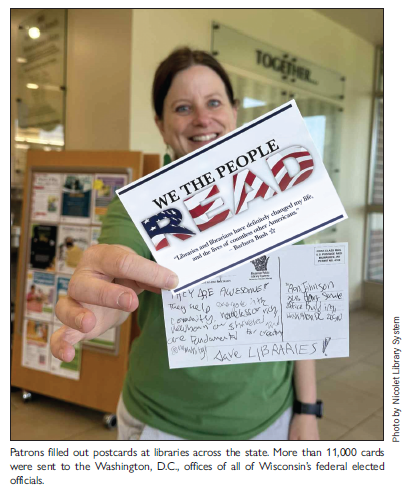
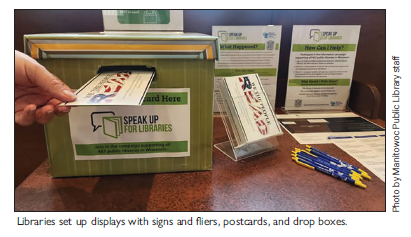
- Postcards on which patrons could write messages to their federal officials (We put drop boxes in the libraries to make sure the cards got mailed.)
- Signs to go along with the postcards; they had short explanations with the QR code to the website, plus a list of senators and representatives with their Washington, D.C., office addresses.
The Internal Campaign for Library Staffers
Our priority was to educate library staffers who may not have been aware of the situation. For this, we decided to rely on the system directors to spearhead the communication channels in their own systems. There was a brief discussion about creating a single comprehensive email list, but we decided it would be too difficult to maintain. Since we would not be directly sending information to them, we decided to create an online toolkit that could be easily updated and easily accessed by anyone at any time.
We created a toolkit with a landing page so staffers could quickly find what they needed (libraries.work). The URL was sent out to all libraries in the state through the communication channels that each system uses (usually an email distribution list for their library directors or an all-staff list). The landing page had direct links to a Google Docs folder from which they could download the following documents and resources:
- Talking points for press interviews
- Social media posts (text and images)
- Links to relevant news articles and state-level information
- Lists of all senators’ and representatives’ Washington, D.C., office addresses
- Templates for mailing labels that librarians could print, to provide patrons with preprinted address labels
Over the next few months, we put our plans into action. All of the assets were created, the library toolkit was populated, and the URL was shared with all of the libraries in the state. At the same time, the public-facing website was launched, and press talking points and press releases were sent out. There were some national news outlets that had picked up the story of the executive order, and libraries started getting calls from local and regional press pretty quickly. Giving them talking points to follow helped keep a consistent message across the state and helped people who are not used to talking to reporters feel more confident.
State Campaign Outcomes
Between March and September 2025, at least 33 articles and interviews were published or broadcast. The public website had 35,335 visits. The culmination of the campaign was the postcard drive. We collected the cards at a central location and mailed them together in two big batches—one in July 2025 and another in August 2025. The idea was to flood the congressional offices with postcards. More than 11,000 cards were sent from our state to every senator and representative from Wisconsin.
Our cohort brought together libraries across Wisconsin to help influence the outcome of this issue, to ensure our patrons’ voices were heard in Washington, and to let our elected officials know how their constituents feel about the importance of libraries. We relied on many forms of technology to make this project a success, from our numerous Zoom meetings to the online platforms we used to disseminate resources and information.
Final National Outcomes
In September 2025, the House and Senate Appropriations Committees endorsed a $291.8 million 2026 budget for IMLS in near-unanimous votes, effectively rejecting the president’s proposal to shutter the agency. Following a joint lawsuit filed by 21 state attorneys general in response to the executive order, a Rhode Island district court judge struck down the executive order in November 2025, and the grant money that had been withheld was released to the states in early December. The administration dropped its appeal in April 2026.
That same month, the White House released its FY2027 budget, which called for eliminating all grant funding for IMLS (again) and included only $6 million for the agency. However, in June 2026, again ignoring the administration’s proposal, the House Appropriations Committee advanced a $291.8 million budget for IMLS for FY2027. As of this writing, the Senate Appropriations Committee has not yet held a vote for FY2027.
We are grateful for the support Congress has shown in continuing to fund our nation’s libraries. We hope our story will inspire other libraries to encourage their patrons to speak up in support of their communities’ libraries if and when the need arises.
|